Quick answer: A trustworthy dashboard starts with owned metric definitions and data tests, not chart selection. Check completeness, uniqueness, timeliness, validity, and reconciliation.
Why this problem persists
A polished dashboard cannot repair ambiguous or inconsistent source definitions. Definitions drift when source systems change, and a dashboard will display the new numbers without any warning that their meaning changed.
Pick one headline metric and write down exactly how it is calculated: the event that counts, the time basis, the level of detail and what is excluded. Then ask the metric owner and one regular user to describe it in their own words. If their descriptions differ from each other or from the calculation, fix the definition before building any chart.
Worked example: Why a beautiful dashboard can be quantitatively wrong
Illustrative scenario. A sales dashboard claims 12% quarter-over-quarter growth. The analyst discovers that the source system switched from 'booked' to 'invoiced' as the revenue event halfway through the quarter. A more attractive chart will not solve a definition mismatch. Before visualization, document the unit of measure, time basis, grain, inclusion rules and reconciliation source.
| Test | Simple method | Interpretation |
|---|---|---|
| Completeness | non-null required fields / eligible records | Report null rate by source |
| Uniqueness | Compare composite business keys | Investigate duplicate events |
| Timeliness | Latest record timestamp vs expected refresh | Flag stale periods |
| Validity | Check allowed status/value ranges | Confirm outliers, don't erase them |
| Reconciliation | Sum signed source amounts vs ledger | Separate rounding from missing rows |
A useful rule: a metric without an owner and definition belongs in 'draft' status, regardless of how plausible it looks. Preserve transformations in version control and sample excluded records. If the dashboard measures a financial or regulated process, involve its designated business/control owner before publishing an authoritative number.
A practical five-step method
1. Define the business question and metric owner before touching data
Get the metric owner to state the business decision, numerator, denominator, time grain, currency or unit and exclusion rule.
2. Profile completeness, uniqueness, timeliness, validity and consistency
Profile fields with sample counts and source timestamps. Run duplicate-key checks and investigate schema changes that could silently alter a trend.
3. Write transformation rules with examples and edge cases
Write transformations as testable mappings, including refunds, null timestamps, canceled records, time zones and revised historical transactions.
4. Test reconciliations against a trusted approved sample
Compare an approved sample to the upstream system or ledger. Document unresolved differences rather than tuning filters until totals happen to match.
5. Publish a reporting specification showing definitions and exclusions
Publish a metric dictionary, data lineage summary, refresh schedule, owner and known limitations alongside the dashboard release.
What “done” should look like
For this problem, aim for a data dictionary, transformation rules and documented test results. It should show provenance, version, owner and outstanding exceptions. The sponsor needs to see what was decided, what was not decided and which actions remain. State the population, sampling method and limitations of any review. A scoped example is not a full assurance engagement.
A quick acceptance test
Ask someone outside the delivery team to locate the latest artifact, identify its accountable owner, explain the top unresolved issue and determine the next authorized action. If any answer depends on someone’s memory, the handoff is incomplete.
Common mistake to avoid
Measuring dashboard adoption while ignoring whether its underlying numbers reconcile. The remedy is not more paperwork for its own sake. Use the smallest set of artifacts that demonstrates scope, evidence, review and the next decision. Automate only after the underlying responsibilities and exceptions are clear.
Copy-ready working checklist
- Define the business question and metric owner before touching data.
- Profile completeness, uniqueness, timeliness, validity and consistency.
- Write transformation rules with examples and edge cases.
- Test reconciliations against a trusted approved sample.
- Publish a reporting specification showing definitions and exclusions.
- Confirm who approves the final output and how corrections will be handled.
- Archive the approved version and record the next review or follow-up date.
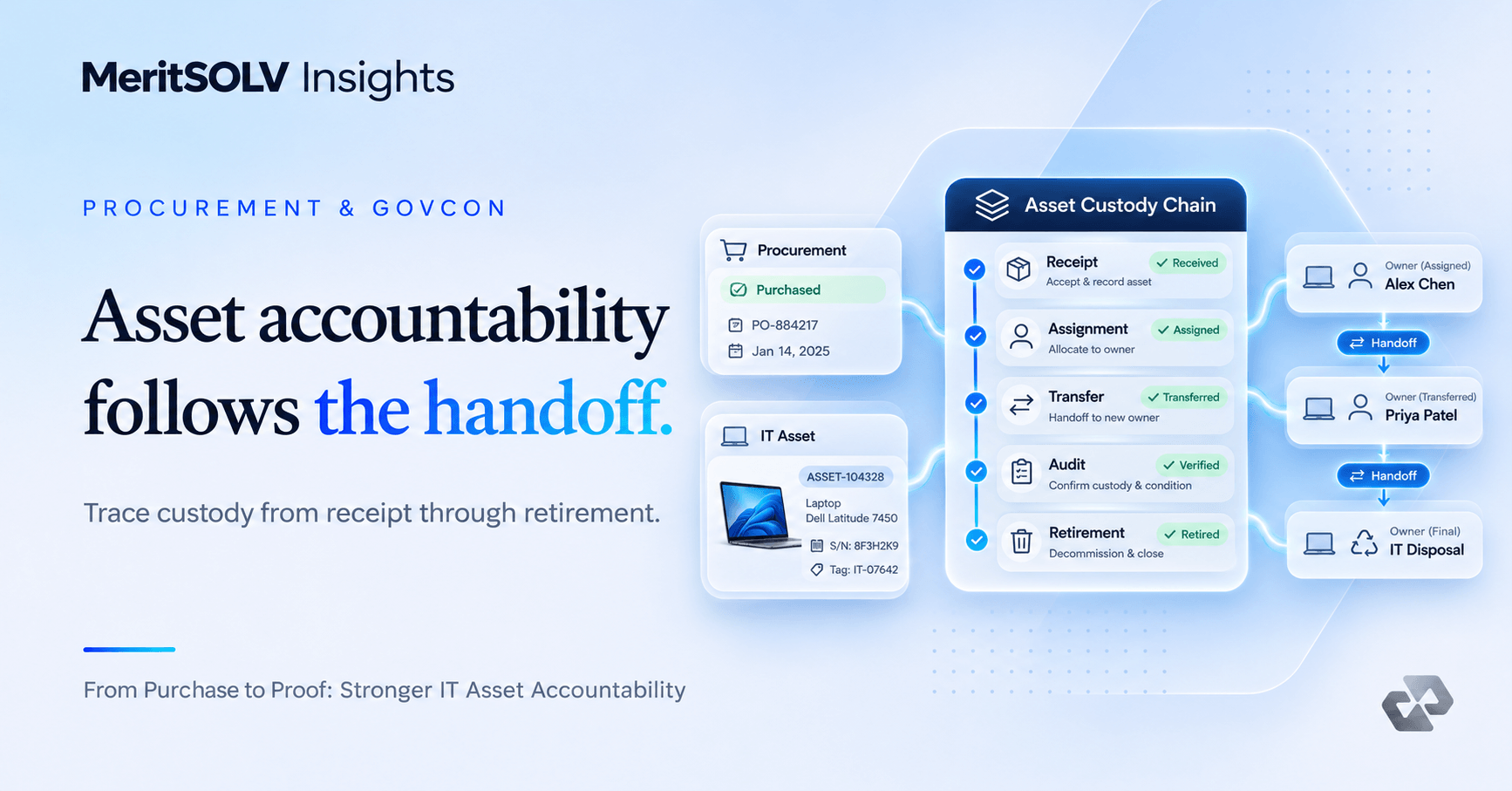
Reconciling against a trusted source is the same test used in IT asset accountability, where purchase records, receiving counts and enrolled devices must agree.
How this connects to MeritSOLV
MeritSOLV currently lists the linked package as available for a scoped proposal, subject to triage and approval.
MeritSOLV’s Business Data Quality Sprint provides a useful next reference for teams that want a defined output rather than an unbounded consulting engagement. Its model emphasizes a written scope, a named delivery lead, independent review and documented acceptance. The decision about what to implement, approve or accept remains with the customer.
For the broader set of options, review the MeritSOLV solution catalog and how the process works. Use a small, well-defined first engagement to validate whether the operating model fits your needs.
Frequently asked questions
What is the first step in data quality?
Agree on precise business definitions and the decision the data will support.
Can this work use synthetic data?
Yes, synthetic or redacted samples can validate rules before approved real-data work.
Standards and further reading
Next step
Choose one real example, complete the checklist, and identify the evidence that would make a decision easier this week. Only after that should you decide whether an internal owner or a scoped external engagement is the right path.
These examples are illustrative, not reports of MeritSOLV™ client engagements. This guide is general operational information, not legal, audit, or certification advice. Review the cited standards and apply your organization's requirements.