Quick answer: Federal proposal readiness begins with a compliance matrix tracing the actual solicitation, amendments, instructions, and evaluation criteria to response owners.
Why this problem persists
Proposal teams lose time when requirements are buried in lengthy solicitation documents. Writers who start drafting before the instructions, evaluation factors and attachments are mapped often discover a missed requirement late in the schedule.
Before any narrative is written, read the solicitation and every amendment once with a single goal: list every instruction, evaluation factor, deadline and required attachment. Give each line an owner and a location in the response. Anything that cannot be assigned yet is an open question to track, not something to assume.
Worked example: Start federal proposal compliance at the requirement level
Illustrative scenario. A contractor opens a 90-page solicitation and starts writing a technical narrative. Two days later it discovers that a mandatory attachment format and staffing certification were omitted. A compliance matrix built first would map each instruction and evaluation factor to a document, owner, response location and verification status.
| Source | Requirement to capture | Internal verification |
|---|---|---|
| Section L or equivalent instructions | Page limits, format, required volumes | Proposal compliance owner |
| Section M or evaluation criteria | Significant evaluation factors | Capture response traceability |
| Section C/PWS | Performance requirement | Solution owner crosswalk |
| Section F | Delivery timing | Scheduler feasibility |
| Amendments / Q&A | Changes from original version | Version-control check |
Do not assume every federal solicitation uses the same format. FAR 15.204 sets out the uniform contract format and common section purposes, but acquisitions may use other prescribed structures. Read the exact solicitation, amendments, and applicable rules. Have a qualified contracts professional validate interpretation. The matrix does not make an offer compliant by itself. It makes omissions easier to detect before submission.
A practical five-step method
1. Use only the approved public solicitation and amendments
Work from an authorized solicitation set and maintain amendments by version and issue date. Explicitly mark information that is not yet available.
2. Extract instructions, evaluation factors, deadlines and required attachments
Extract each mandatory instruction, page limit, attachment, submission rule, evaluation factor and deadline into a searchable matrix.
3. Assign each requirement to a response owner and source evidence
Tie requirements to an evidence source, response owner, proposal section and verification state. Link cross-references rather than duplicate stale text.
4. Schedule color-team or internal reviews around the submission calendar
Place solution, compliance and executive reviews before final production deadlines, leaving time for amendments and file-format checks.
5. Track unanswered questions and readiness without assuming eligibility or award
Track uncertain interpretation and eligibility as unresolved questions for approved contracts counsel, not as guessed compliance statements.
What “done” should look like
For this problem, aim for an auditable solicitation requirement matrix and response-readiness tracker. It should show provenance, version, owner and outstanding exceptions. The sponsor needs to see what was decided, what was not decided and which actions remain. State the population, sampling method and limitations of any review. A scoped example is not a full assurance engagement.
A quick acceptance test
Ask someone outside the delivery team to locate the latest artifact, identify its accountable owner, explain the top unresolved issue and determine the next authorized action. If any answer depends on someone’s memory, the handoff is incomplete.
Common mistake to avoid
Writing polished narrative before checking whether every mandatory section is covered. The remedy is not more paperwork for its own sake. Use the smallest set of artifacts that demonstrates scope, evidence, review and the next decision. Automate only after the underlying responsibilities and exceptions are clear.
Copy-ready working checklist
- Use only the approved public solicitation and amendments.
- Extract instructions, evaluation factors, deadlines and required attachments.
- Assign each requirement to a response owner and source evidence.
- Schedule color-team or internal reviews around the submission calendar.
- Track unanswered questions and readiness without assuming eligibility or award.
- Confirm who approves the final output and how corrections will be handled.
- Archive the approved version and record the next review or follow-up date.
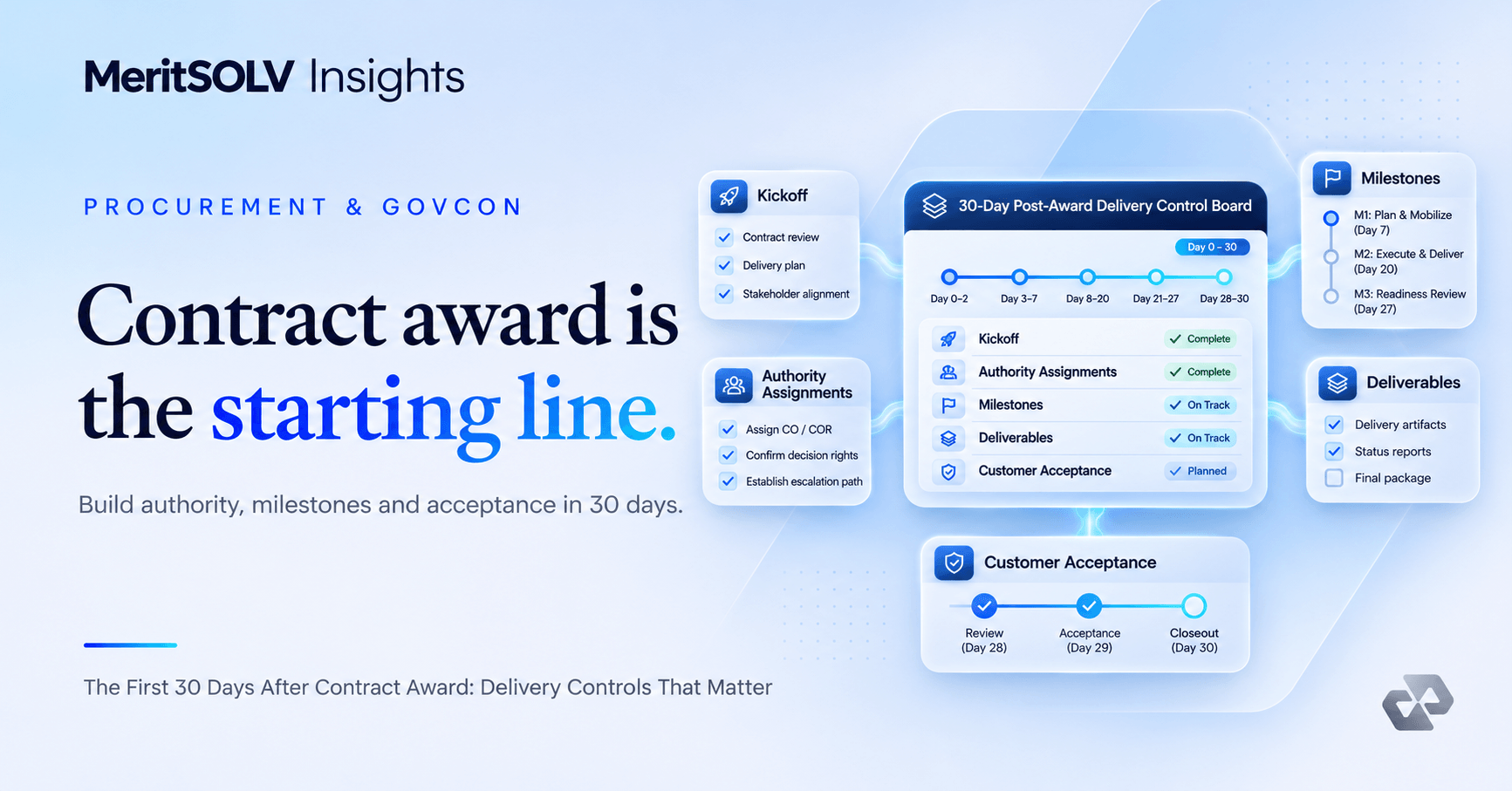
The same requirement-level discipline carries into delivery, as covered in the first 30 days after contract award.
How this connects to MeritSOLV
MeritSOLV currently lists the linked package as available for a scoped proposal, subject to triage and approval.
MeritSOLV’s GovCon Proposal Readiness Sprint provides a useful next reference for teams that want a defined output rather than an unbounded consulting engagement. Its model emphasizes a written scope, a named delivery lead, independent review and documented acceptance. The decision about what to implement, approve or accept remains with the customer.
For the broader set of options, review the MeritSOLV solution catalog and how the process works. Use a small, well-defined first engagement to validate whether the operating model fits your needs.
Frequently asked questions
What is a proposal compliance matrix?
A structured map between solicitation requirements and the response location, owner and completion evidence.
Does a proposal matrix guarantee responsiveness?
No. Authorized bid leaders and applicable legal/procurement experts retain that responsibility.
Standards and further reading
Next step
Choose one real example, complete the checklist, and identify the evidence that would make a decision easier this week. Only after that should you decide whether an internal owner or a scoped external engagement is the right path.
These examples are illustrative, not reports of MeritSOLV™ client engagements. This guide is general operational information, not legal, audit, or certification advice. Review the cited standards and apply your organization's requirements.