Quick answer: The first month after award needs a contract baseline, accountable governance, acceptance workflow, controlled issues, and a clear authority path.
Why this problem persists
A contract win can still become a delivery problem without disciplined mobilization. Proposal assumptions, kickoff slides and staffing plans do not by themselves give a team an approved baseline, a working acceptance process or a clear line of authority.
Early in mobilization, list every deliverable and deadline in the final contract and compare it with what the proposal team assumed. Then name who can approve work, who can accept deliverables and who may authorize changes. Any item without a clear answer goes into the assumptions log for resolution through the contract's authorized channels.
Worked example: Post-award mobilization as a controlled transition
Illustrative scenario. A team wins a service contract with a 30-day transition window. It has staffing names and a kickoff slide deck but no approved deliverable repository or acceptance workflow. Build a Day 0 to 30 mobilization matrix with a dated owner, blocker and proof for each transition requirement.
| When | Control | Proof |
|---|---|---|
| Days 0 to 5 | Interpret final award and changes | Approved contract baseline |
| Days 5 to 10 | Set governance and authority | RACI/contact roster |
| Days 10 to 20 | Confirm access, deliverables, onboarding | Access approvals and milestone plan |
| Days 20 to 30 | Run initial reporting and acceptance | Sample report, issue log, sign-off |
Avoid early work beyond the awarded scope. Changes and direction may require contracting-officer action, depending on contract terms. Program staff should not assume they can authorize contract modifications. Maintain an assumptions log and elevate ambiguities using the contract's authorized channels. If staffing or security prerequisites are late, report the impact transparently rather than hiding it in a green status dashboard.
A practical five-step method
1. Extract deliverables and deadlines from approved unclassified contract materials
Read the final contract, delivery schedule and attachments. Convert obligations into a controlled register without substituting proposal assumptions.
2. Create a decision-rights and stakeholder contact matrix
Define the contracting authority, program lead, security contacts, delivery owners and escalation chain with a formal decision-rights table.
3. Set milestone reporting and communications routines
Set a reporting rhythm that contains accepted work, pending evidence, schedule threats and decisions needed from the client.
4. Establish change, issue and risk escalation procedures
Escalate work outside the authorized scope through the contract’s prescribed mechanism rather than executing informal requests.
5. Rehearse the manager handoff and record open assumptions
Test a sample deliverable handoff with its approval checklist, document unresolved access and personnel dependencies, and secure sponsor acceptance.
What “done” should look like
For this problem, aim for a kickoff checklist, milestone register and manager-ready control pack. It should show provenance, version, owner and outstanding exceptions. The sponsor needs to see what was decided, what was not decided and which actions remain. State the population, sampling method and limitations of any review. A scoped example is not a full assurance engagement.
A quick acceptance test
Ask someone outside the delivery team to locate the latest artifact, identify its accountable owner, explain the top unresolved issue and determine the next authorized action. If any answer depends on someone’s memory, the handoff is incomplete.
Common mistake to avoid
Confusing proposal assumptions with authorized post-award obligations. The remedy is not more paperwork for its own sake. Use the smallest set of artifacts that demonstrates scope, evidence, review and the next decision. Automate only after the underlying responsibilities and exceptions are clear.
Copy-ready working checklist
- Extract deliverables and deadlines from approved unclassified contract materials.
- Create a decision-rights and stakeholder contact matrix.
- Set milestone reporting and communications routines.
- Establish change, issue and risk escalation procedures.
- Rehearse the manager handoff and record open assumptions.
- Confirm who approves the final output and how corrections will be handled.
- Archive the approved version and record the next review or follow-up date.
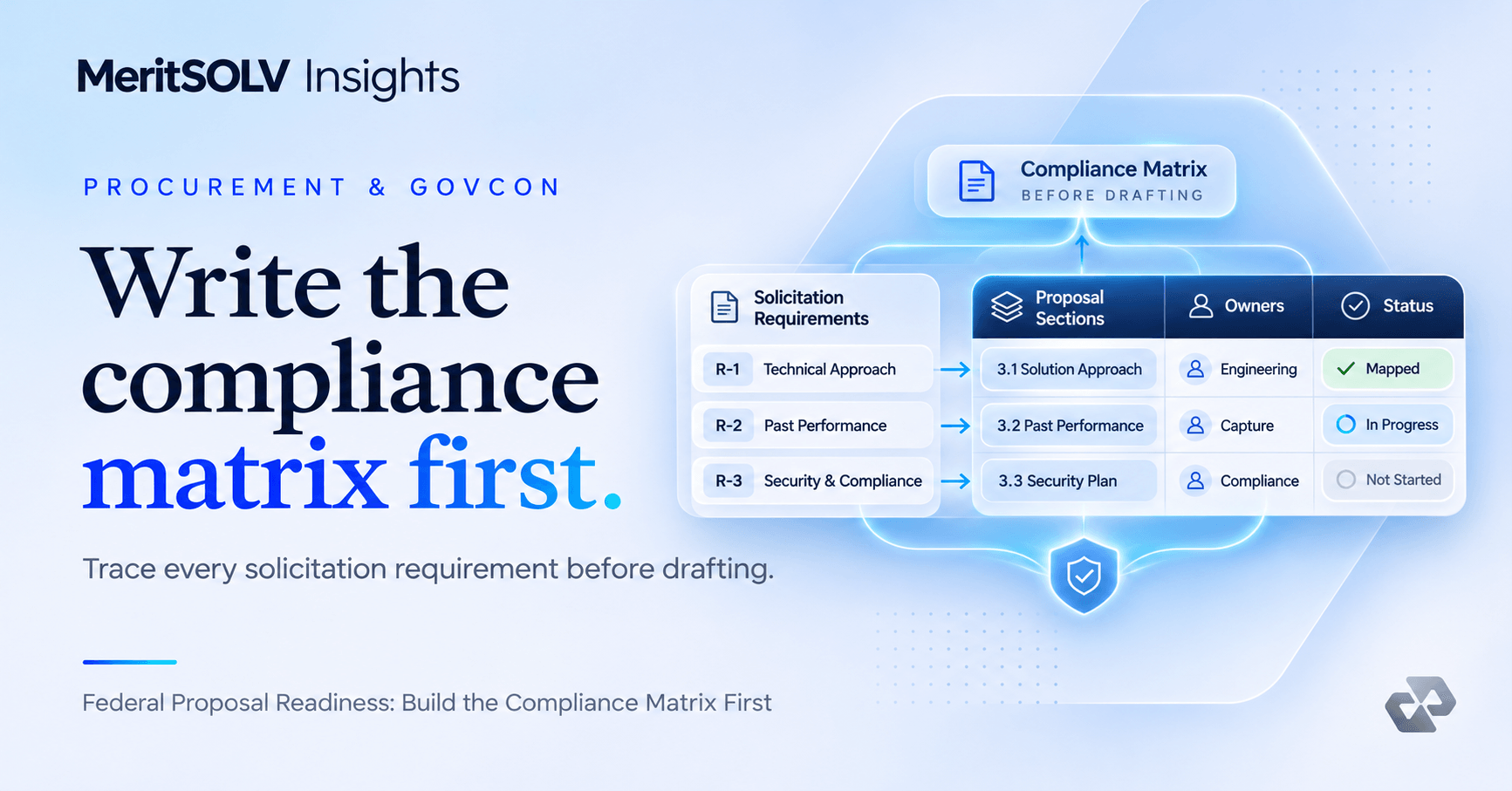
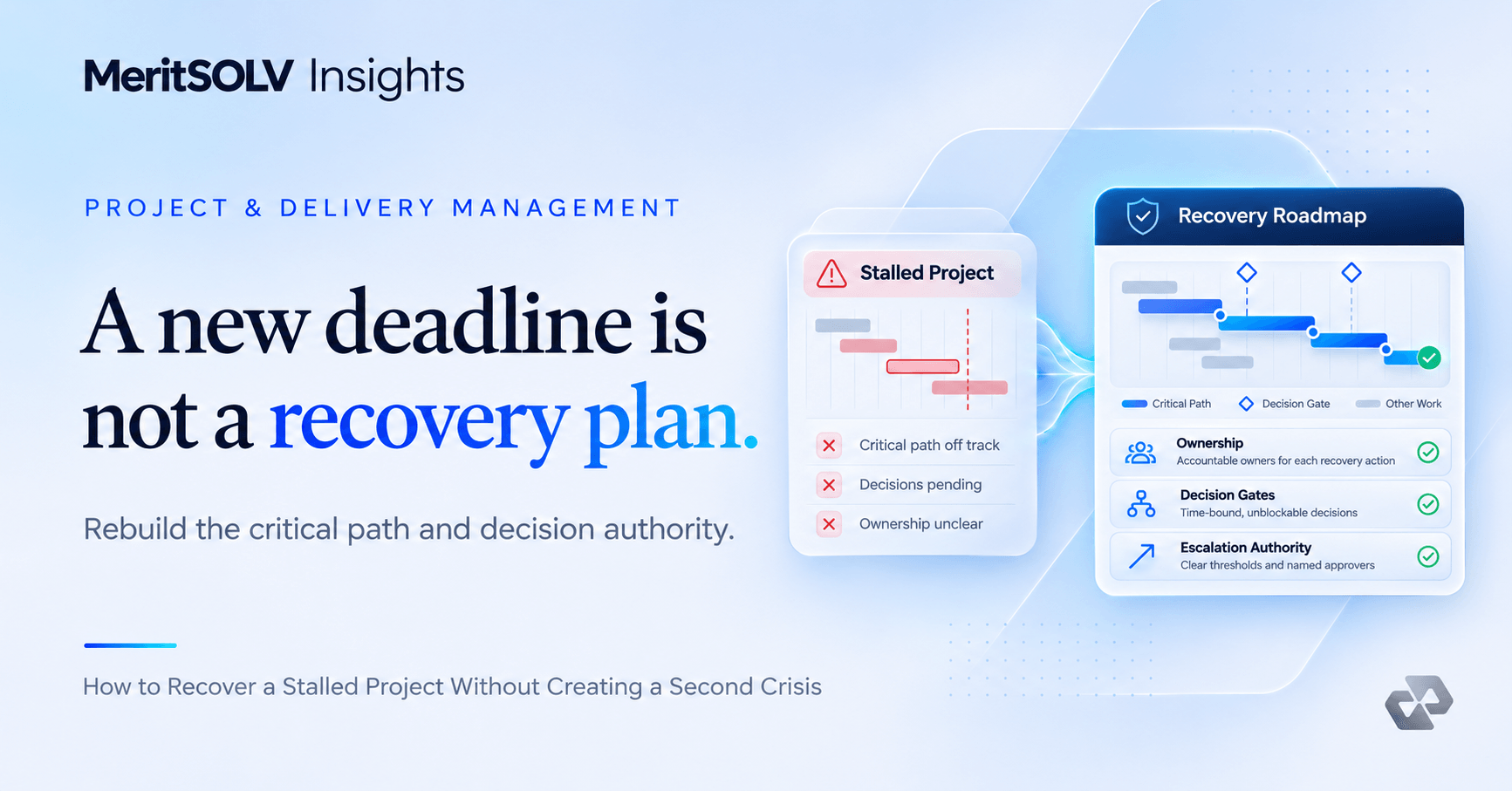
The compliance matrix built for federal proposal readiness is a good starting point for the contract baseline. If mobilization slips anyway, the method in how to recover a stalled project helps reset it without a second crisis.
How this connects to MeritSOLV
MeritSOLV currently lists the linked package as available for a scoped proposal, subject to triage and approval.
MeritSOLV’s Contract Mobilization Delivery Controls provides a useful next reference for teams that want a defined output rather than an unbounded consulting engagement. Its model emphasizes a written scope, a named delivery lead, independent review and documented acceptance. The decision about what to implement, approve or accept remains with the customer.
For the broader set of options, review the MeritSOLV solution catalog and how the process works. Use a small, well-defined first engagement to validate whether the operating model fits your needs.
Frequently asked questions
What belongs in a mobilization checklist?
Owners, deliverables, acceptance expectations, communications, risks and escalation routes.
Can an external team interpret contract obligations?
Legal or binding interpretation requires authorized professionals. Delivery tools should use approved inputs.
Standards and further reading
Next step
Choose one real example, complete the checklist, and identify the evidence that would make a decision easier this week. Only after that should you decide whether an internal owner or a scoped external engagement is the right path.
These examples are illustrative, not reports of MeritSOLV™ client engagements. This guide is general operational information, not legal, audit, or certification advice. Review the cited standards and apply your organization's requirements.