Quick answer: A skills matrix should reveal whether critical tasks have demonstrated primary and backup coverage, not merely count training courses completed.
Why this problem persists
Headcount alone does not show whether critical tasks have qualified coverage. Certifications, course completions and job titles describe what people have studied, not who can actually run a critical task on a bad day.
A quick first test is to pick one critical service, such as the identity platform or backups, and list every task needed to keep it running. Next to each task, write the people who have done it recently under observation, not the people who could probably do it. Tasks with one name, or with names that are often unavailable at the same time, are your real coverage gaps.
Worked example: Coverage is a resilience measure, not a training count
Illustrative scenario. A 15-person IT team can operate the production identity platform only when one senior administrator is available. A training catalog shows plenty of certifications, but the operational coverage gap remains. Build a matrix around demonstrated tasks, backup availability and escalation readiness.
| Critical task | Primary coverage | Verified backup | Risk disposition |
|---|---|---|---|
| Rotate emergency credentials | One qualified owner | None | Create supervised cross-training |
| Restore shared database | Two trained staff | One has tested restore | Retest backup operator |
| Approve firewall changes | Two approvers | Yes | Maintain rotation |
| Maintain vendor escalation | One contact | Documented delegate | Test contact chain |
Define 'capable' with evidence: observed task completion, reviewed runbook execution, or supervised exercise. Do not turn personal performance data into public rankings. Plan capacity for leave, incidents and simultaneous events. A two-person roster may still be a single point of failure if both are unavailable in the same window. Where relevant, NICE task/knowledge/skill statements can help normalize role language.
A practical five-step method
1. List the critical services and tasks that must be supported
Enumerate recovery, access, administration, escalation and approval tasks whose failure would materially affect critical services.
2. Define proficiency levels using observable evidence
Define skill levels using repeatable observations: can explain, can execute with supervision, can execute independently, can review or teach.
3. Map current personnel to demonstrated rather than assumed capabilities
Require evidence such as a recent supervised restore, approved change or reviewed runbook, not a self-rating or attendance certificate alone.
4. Identify single points of failure and succession dependencies
Highlight tasks with only one demonstrably capable operator, shared absence windows, weak on-call coverage or untested substitutes.
5. Create role-based development actions and retest coverage
Assign cross-training and supervised exercises to specific coverage gaps, then verify the backup can perform the task after instruction.
What “done” should look like
For this problem, aim for a role-to-capability matrix and prioritized development decisions. It should show provenance, version, owner and outstanding exceptions. The sponsor needs to see what was decided, what was not decided and which actions remain. State the population, sampling method and limitations of any review. A scoped example is not a full assurance engagement.
A quick acceptance test
Ask someone outside the delivery team to locate the latest artifact, identify its accountable owner, explain the top unresolved issue and determine the next authorized action. If any answer depends on someone’s memory, the handoff is incomplete.
Common mistake to avoid
Counting course completions as proof of operational readiness. The remedy is not more paperwork for its own sake. Use the smallest set of artifacts that demonstrates scope, evidence, review and the next decision. Automate only after the underlying responsibilities and exceptions are clear.
Copy-ready working checklist
- List the critical services and tasks that must be supported.
- Define proficiency levels using observable evidence.
- Map current personnel to demonstrated rather than assumed capabilities.
- Identify single points of failure and succession dependencies.
- Create role-based development actions and retest coverage.
- Confirm who approves the final output and how corrections will be handled.
- Archive the approved version and record the next review or follow-up date.
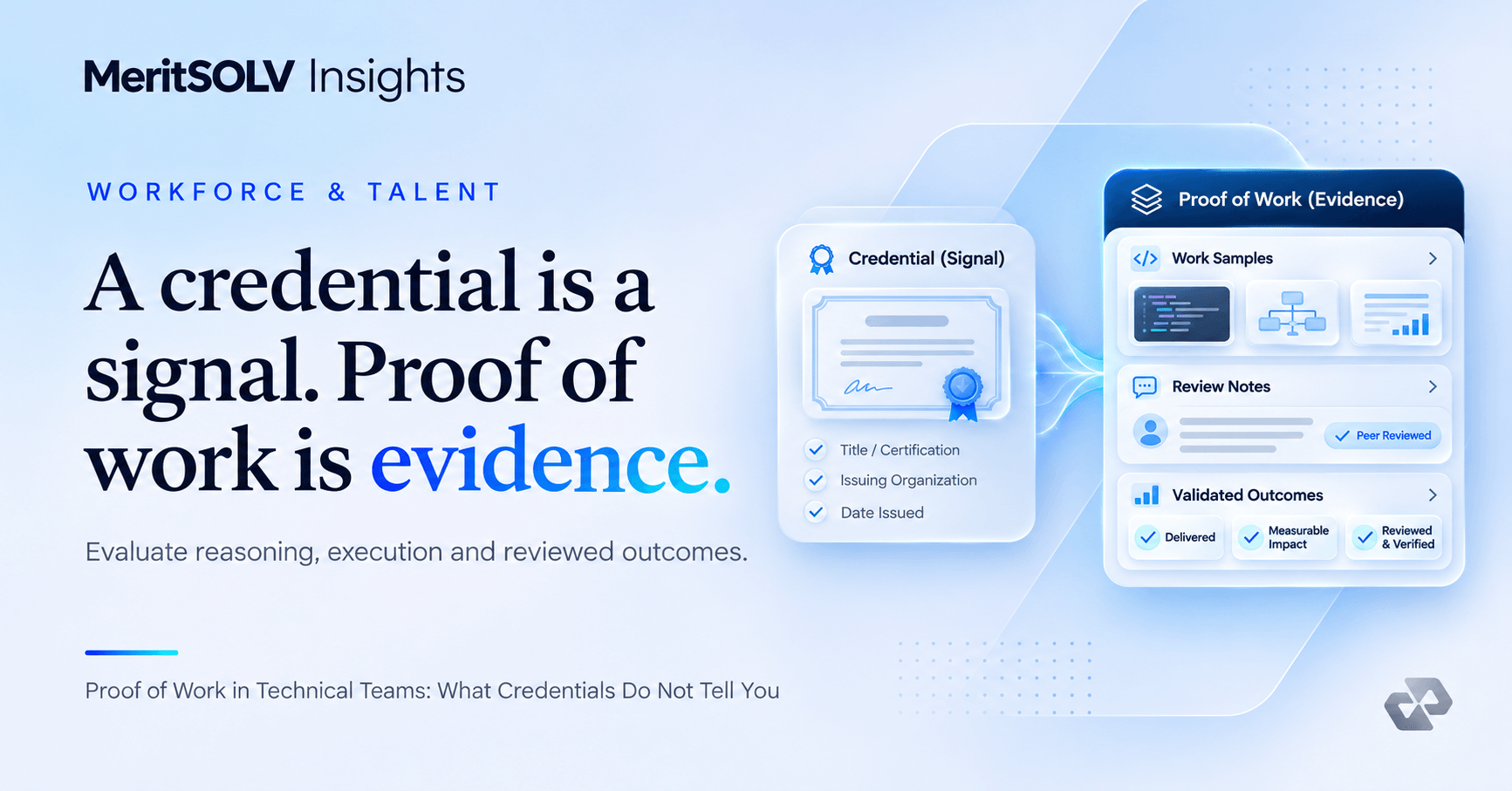
To decide what counts as demonstrated, use the work-sample approach in proof of work in technical teams rather than self-ratings.
How this connects to MeritSOLV
MeritSOLV’s Workforce Capability & Technical Enablement provides a useful next reference for teams that want a defined output rather than an unbounded consulting engagement. Its model emphasizes a written scope, a named delivery lead, independent review and documented acceptance. The decision about what to implement, approve or accept remains with the customer.
For the broader set of options, review the MeritSOLV solution catalog and how the process works. Use a small, well-defined first engagement to validate whether the operating model fits your needs.
Frequently asked questions
What should a skills matrix measure?
The skills required by defined tasks and verified levels of coverage, not just self-ratings.
Should a skills matrix become a hiring score?
Only with fair, job-relevant, consistently applied criteria and appropriate review.
Standards and further reading
Next step
Choose one real example, complete the checklist, and identify the evidence that would make a decision easier this week. Only after that should you decide whether an internal owner or a scoped external engagement is the right path.
These examples are illustrative, not reports of MeritSOLV™ client engagements. This guide is general operational information, not legal, audit, or certification advice. Review the cited standards and apply your organization's requirements.