Quick answer: Technical capability is better assessed with responsibly obtained work samples, task reasoning, and reviewed outcomes in addition to credentials.
Why this problem persists
Certifications establish knowledge but not every dimension of delivery performance. A credential shows what someone has learned, but it does not show how they reason through an unfamiliar problem or handle uncertainty.
Define one task that reflects the real work of the role, along with a short rubric describing what a strong response looks like. Ask candidates to explain their decisions and what they would check next, using redacted or synthetic material. The explanation often tells you more than the final answer.
Worked example: Technical proof should demonstrate reasoning, not just a badge
Illustrative scenario. Two applicants have the same security credential. One submits a sanitized incident timeline describing an authentication anomaly, the detection signal, triage decisions, uncertainty and lessons learned. The other submits only a badge. Neither artifact automatically proves performance in a production environment, but a structured work sample gives the reviewer more observable evidence.
| Proof element | Evaluator question |
|---|---|
| Task context | Was the task representative and appropriately scoped? |
| Decision trail | Can the person explain alternatives considered? |
| Artifact quality | Is the output reproducible and professionally documented? |
| Feedback loop | What changed after review or testing? |
| Confidentiality | Was proprietary/sensitive data removed with permission? |
Avoid false precision. A single assessment, credential or project artifact is not a complete employment prediction. Use multiple methods where practicable, apply consistent rubrics and accommodations, and never solicit unauthorized customer data. The NIST NICE Framework provides a task/knowledge/skill vocabulary that can make evidence-based evaluation more consistent.
A practical five-step method
1. Separate learned knowledge from applied task evidence
Map the actual tasks the role performs to knowledge assessment, applied sample and collaborative review rather than treating credentials as the only filter.
2. Define work samples appropriate to the role and risk
Design permission-safe representative tasks with a documented rubric and accommodations. Do not request work product containing another customer’s secrets.
3. Review context, constraints, attribution and independent feedback
Ask applicants to explain choices, trade-offs, sources and feedback, and distinguish their own contribution from a team or automated output.
4. Respect confidentiality when documenting client work
Use redaction or synthetic examples when client work is involved. Verify candidates have permission to share any proprietary material.
5. Track demonstrated capabilities and limitations over time
Record demonstrated task types, strengths and development needs with reviewer notes, and revisit claims as the role or technology changes.
What “done” should look like
For this problem, aim for a defensible evidence profile tied to specific kinds of work. It should show provenance, version, owner and outstanding exceptions. The sponsor needs to see what was decided, what was not decided and which actions remain. State the population, sampling method and limitations of any review. A scoped example is not a full assurance engagement.
A quick acceptance test
Ask someone outside the delivery team to locate the latest artifact, identify its accountable owner, explain the top unresolved issue and determine the next authorized action. If any answer depends on someone’s memory, the handoff is incomplete.
Common mistake to avoid
Treating training completion as blanket authorization for privileged or senior duties. The remedy is not more paperwork for its own sake. Use the smallest set of artifacts that demonstrates scope, evidence, review and the next decision. Automate only after the underlying responsibilities and exceptions are clear.
Copy-ready working checklist
- Separate learned knowledge from applied task evidence.
- Define work samples appropriate to the role and risk.
- Review context, constraints, attribution and independent feedback.
- Respect confidentiality when documenting client work.
- Track demonstrated capabilities and limitations over time.
- Confirm who approves the final output and how corrections will be handled.
- Archive the approved version and record the next review or follow-up date.
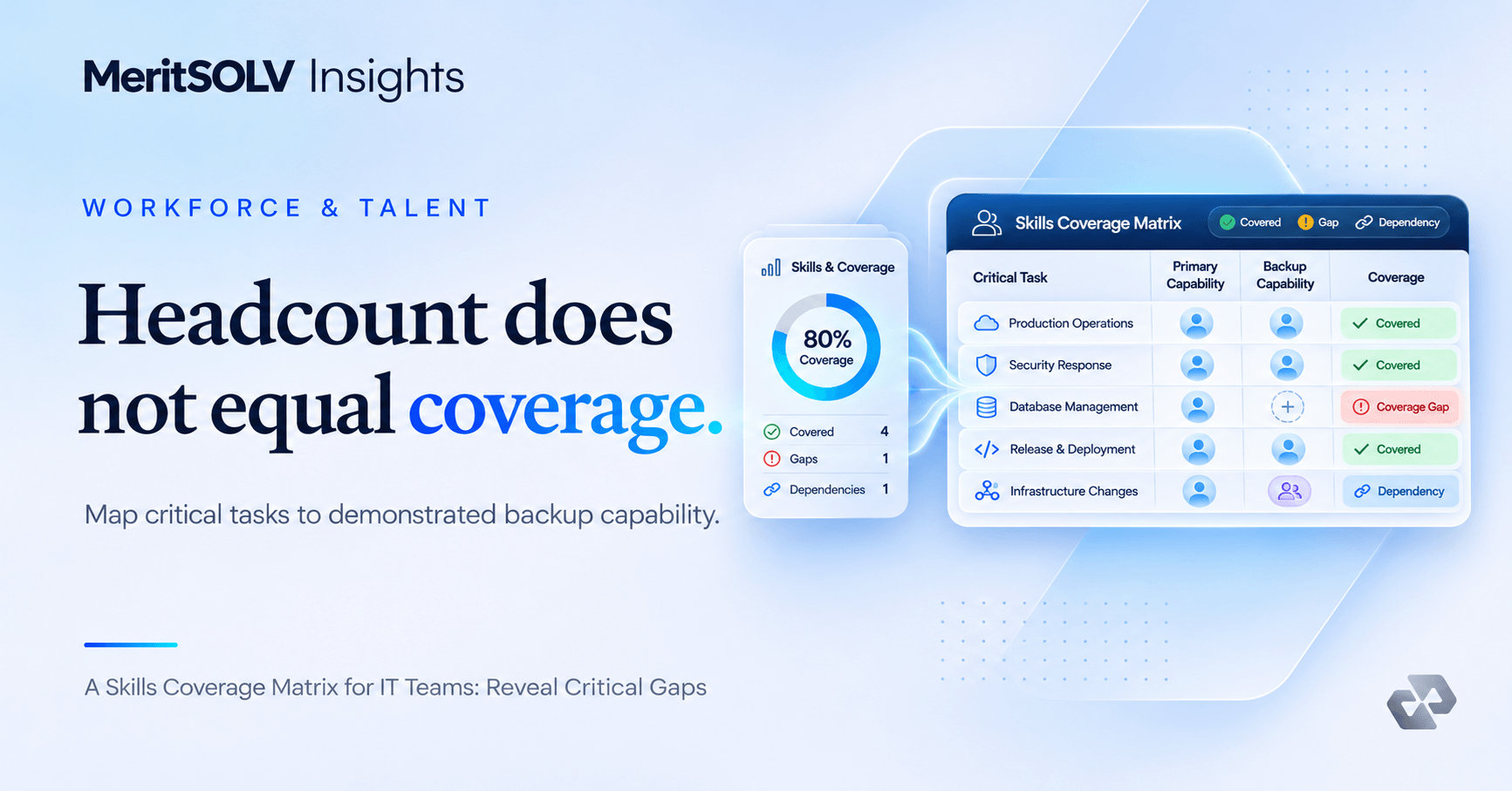
Once individual evidence is collected, a skills coverage matrix shows whether the team as a whole has backup for its critical tasks.
How this connects to MeritSOLV
MeritSOLV’s professional participation model provides a useful next reference for teams that want a defined output rather than an unbounded consulting engagement. Its model emphasizes a written scope, a named delivery lead, independent review and documented acceptance. The decision about what to implement, approve or accept remains with the customer.
For the broader set of options, review the MeritSOLV solution catalog and how the process works. Use a small, well-defined first engagement to validate whether the operating model fits your needs.
Frequently asked questions
Do certifications still matter?
Yes. They can signal knowledge, while role-specific evidence demonstrates applied execution.
How can confidential work be represented?
Use approved redacted summaries or anonymized outcomes, never restricted client artifacts.
Standards and further reading
Next step
Choose one real example, complete the checklist, and identify the evidence that would make a decision easier this week. Only after that should you decide whether an internal owner or a scoped external engagement is the right path.
These examples are illustrative, not reports of MeritSOLV™ client engagements. This guide is general operational information, not legal, audit, or certification advice. Review the cited standards and apply your organization's requirements.