Quick answer: Vendor-risk reviews become useful when supplier statements are connected to relevant exposure, dated evidence, acceptance conditions, and a named risk owner.
Why this problem persists
Vendor questionnaires generate documents but often no defensible decision. Long questionnaires full of yes answers can still leave the decision undocumented, with no one named as accepting the remaining risk.
Pick one critical vendor and write down what it actually does with your data, how it connects to your systems and which subcontractors it uses. Then check which questionnaire answers relate to those exposures and whether each is supported by dated evidence. The answers that matter usually fit on one page, and that page is what the risk owner signs.
Worked example: Decision rules beat long questionnaires
Illustrative scenario. A midsize organization reviews two customer-data vendors. Both provide glossy security questionnaires, but one subprocessor list is 18 months old and the other cannot explain deletion after contract termination. Instead of scoring the number of affirmative answers, the reviewer maps the evidence to four business exposures: data categories, access paths, subcontracting and service continuity.
| Decision area | Verify | Possible result |
|---|---|---|
| Data processing | Actual data flow and retention term | Approval with data minimization |
| Identity control | SSO/MFA configuration responsibility | Required configuration before go-live |
| Subprocessors | Current list, notice terms | Contract condition |
| Exit readiness | Deletion proof and export format | Hold until tested |
Distinguish missing evidence from failed controls. 'Not supplied' should trigger a request, risk acceptance or exclusion. It should not be converted automatically into 'insecure.' Record the business owner who may accept residual risk and the conditions that would reopen the decision. NIST CSF 2.0 explicitly recognizes supply-chain risk as part of organizational cybersecurity governance.
A practical five-step method
1. Segment suppliers by service criticality and information access
Tier vendors by data sensitivity, system integration, availability dependence and subcontractor exposure. A low-risk printing vendor needs different proof from a payment processor.
2. Request evidence only for controls relevant to the exposure
Use a control request tailored to the exposure. Request a current scope statement, responsible contacts, contractual commitments and supporting assessment evidence where justified.
3. Track statements to supporting artifacts and validity dates
For each yes response, capture an artifact, relevant service boundary and freshness date. Mark unknown rather than assuming that a vendor policy covers the purchased service.
4. Log deficiencies with severity, owner and due date
Describe an issue in terms of likelihood and business consequence, list available mitigations and specify who must supply evidence by which date.
5. Escalate residual risk to the proper business decision-maker
Record whether the buyer accepts, conditions, defers or rejects the exposure. Security can inform but may not have authority to approve business risk.
What “done” should look like
For this problem, aim for a consolidated vendor evidence index and deficiency register. It should show provenance, version, owner and outstanding exceptions. The sponsor needs to see what was decided, what was not decided and which actions remain. State the population, sampling method and limitations of any review. A scoped example is not a full assurance engagement.
A quick acceptance test
Ask someone outside the delivery team to locate the latest artifact, identify its accountable owner, explain the top unresolved issue and determine the next authorized action. If any answer depends on someone’s memory, the handoff is incomplete.
Common mistake to avoid
Accepting a vendor checkmark without tying it to a current, scoped artifact. The remedy is not more paperwork for its own sake. Use the smallest set of artifacts that demonstrates scope, evidence, review and the next decision. Automate only after the underlying responsibilities and exceptions are clear.
Copy-ready working checklist
- Segment suppliers by service criticality and information access.
- Request evidence only for controls relevant to the exposure.
- Track statements to supporting artifacts and validity dates.
- Log deficiencies with severity, owner and due date.
- Escalate residual risk to the proper business decision-maker.
- Confirm who approves the final output and how corrections will be handled.
- Archive the approved version and record the next review or follow-up date.
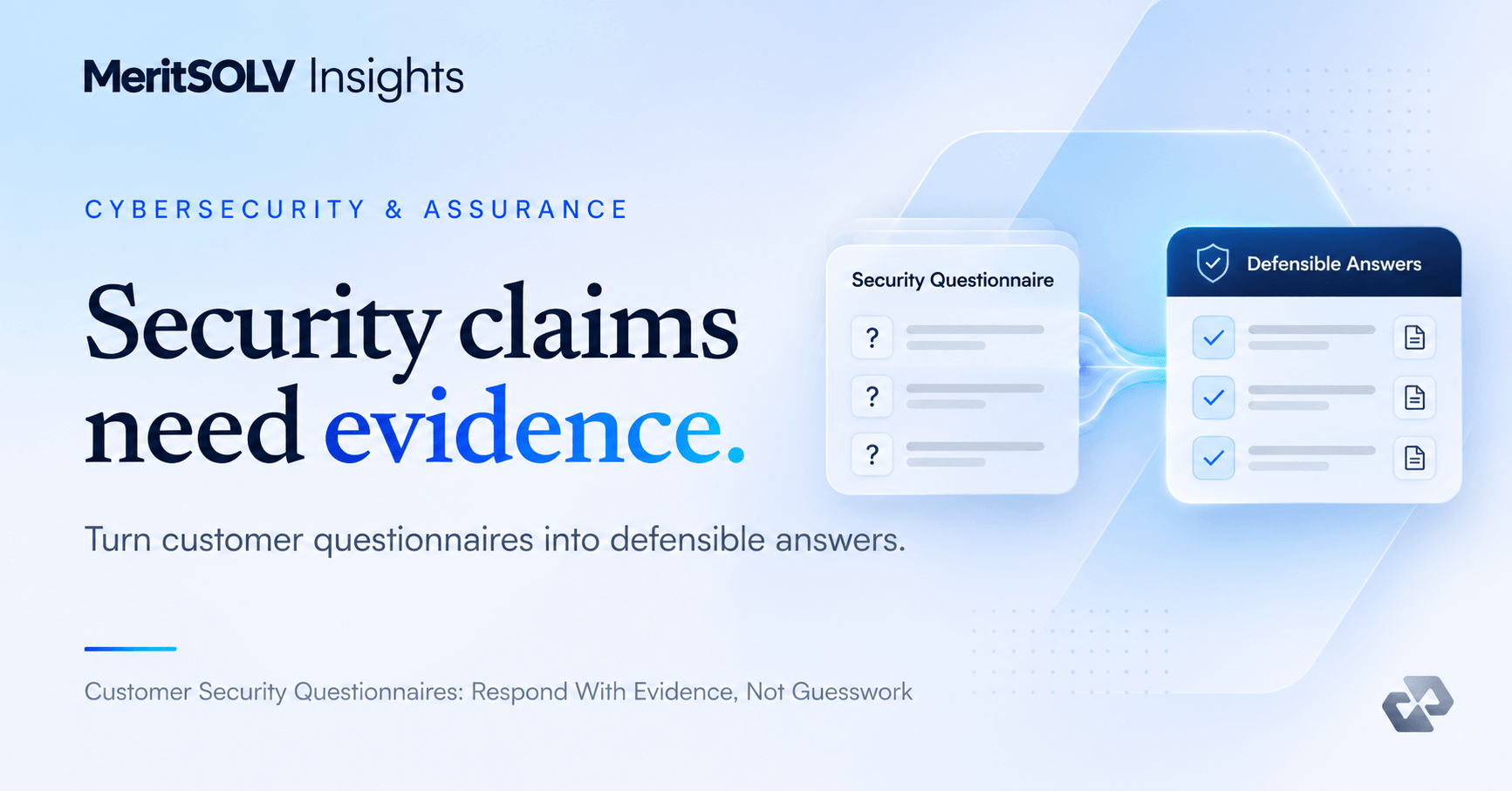
If your organization also answers questionnaires from its own customers, the evidence-based response approach uses the same claim and evidence logic.
How this connects to MeritSOLV
MeritSOLV currently lists the linked package as available for a scoped proposal, subject to triage and approval.
MeritSOLV’s Vendor Risk Evidence Packet provides a useful next reference for teams that want a defined output rather than an unbounded consulting engagement. Its model emphasizes a written scope, a named delivery lead, independent review and documented acceptance. The decision about what to implement, approve or accept remains with the customer.
For the broader set of options, review the MeritSOLV solution catalog and how the process works. Use a small, well-defined first engagement to validate whether the operating model fits your needs.
Frequently asked questions
What evidence should suppliers provide?
It varies by risk: policies, independently assessed reports, incident procedures and access controls may be relevant.
Who accepts residual vendor risk?
An authorized business or risk owner, not the analyst assembling the questionnaire.
Standards and further reading
Next step
Choose one real example, complete the checklist, and identify the evidence that would make a decision easier this week. Only after that should you decide whether an internal owner or a scoped external engagement is the right path.
These examples are illustrative, not reports of MeritSOLV™ client engagements. This guide is general operational information, not legal, audit, or certification advice. Review the cited standards and apply your organization's requirements.