Quick answer: Answer customer security questionnaires with bounded, preapproved claims linked to current evidence and a reviewer, rather than broad, unverified promises.
Why this problem persists
A single unsupported assurance can create more risk than an incomplete response. Under deadline pressure, teams often reuse old answers or say yes to broad questions that only partly apply.
Take the last questionnaire your team completed and highlight every answer that made an absolute claim, such as all, always or never. For each one, check whether current evidence covers every system and data flow in scope. Answers that cannot be supported should be narrowed, qualified or routed to the security owner before they go into the answer library.
Worked example: The answer bank that won't overpromise
Illustrative scenario. Sales receives a 120-question security questionnaire with a 48-hour deadline. One question asks whether 'all data is encrypted.' A blanket yes could be misleading if some backups, logs or third-party flows use different controls. The response owner should ask for system boundary and scope, then reference a reviewed claim with supporting evidence and an expiry date.
| Answer record | Why it matters |
|---|---|
| Exact question and customer context | Prevents inappropriate reuse |
| Approved answer with qualifier | Avoids sweeping claims |
| Evidence link and owner | Supports review and revalidation |
| Valid-through date | Triggers refresh after material change |
| Exceptions or limitations | Preserves defensibility |
Build a 'claim library,' not a marketing FAQ. The security team approves technical claims, legal reviews contractual commitments, and the account team communicates the outcome. Flag requests that seek confidential penetration-testing details, secrets or personal information for controlled handling. The goal is accurate, repeatable responses, not guaranteed assurance.
A practical five-step method
1. Assign an authorized reviewer for each control topic
Split a questionnaire by control domain and assign reviewers who can actually validate identity, logging, data retention and incident-response statements.
2. Create an answer library linked to approved evidence
Store approved responses with exact wording, source evidence, system scope, sensitivity marking and revalidation date. Avoid copying old sales answers.
3. Distinguish current controls from planned improvements
Differentiate implemented controls from scheduled work, and include a qualifier when a claim applies only to a particular environment or customer tier.
4. Mark unanswered or sensitive requests for clarification
Escalate requests for secrets, test reports, personnel data or impossible blanket assertions through established confidentiality and legal channels.
5. Require sponsor approval before sharing external statements
Require release approval by the accountable security/business authority before any customer-facing representation or commitment is sent.
What “done” should look like
For this problem, aim for an evidence-linked response pack and approved answer library. It should show provenance, version, owner and outstanding exceptions. The sponsor needs to see what was decided, what was not decided and which actions remain. State the population, sampling method and limitations of any review. A scoped example is not a full assurance engagement.
A quick acceptance test
Ask someone outside the delivery team to locate the latest artifact, identify its accountable owner, explain the top unresolved issue and determine the next authorized action. If any answer depends on someone’s memory, the handoff is incomplete.
Common mistake to avoid
Copying last year’s answer without checking the current service boundary. The remedy is not more paperwork for its own sake. Use the smallest set of artifacts that demonstrates scope, evidence, review and the next decision. Automate only after the underlying responsibilities and exceptions are clear.
Copy-ready working checklist
- Assign an authorized reviewer for each control topic.
- Create an answer library linked to approved evidence.
- Distinguish current controls from planned improvements.
- Mark unanswered or sensitive requests for clarification.
- Require sponsor approval before sharing external statements.
- Confirm who approves the final output and how corrections will be handled.
- Archive the approved version and record the next review or follow-up date.
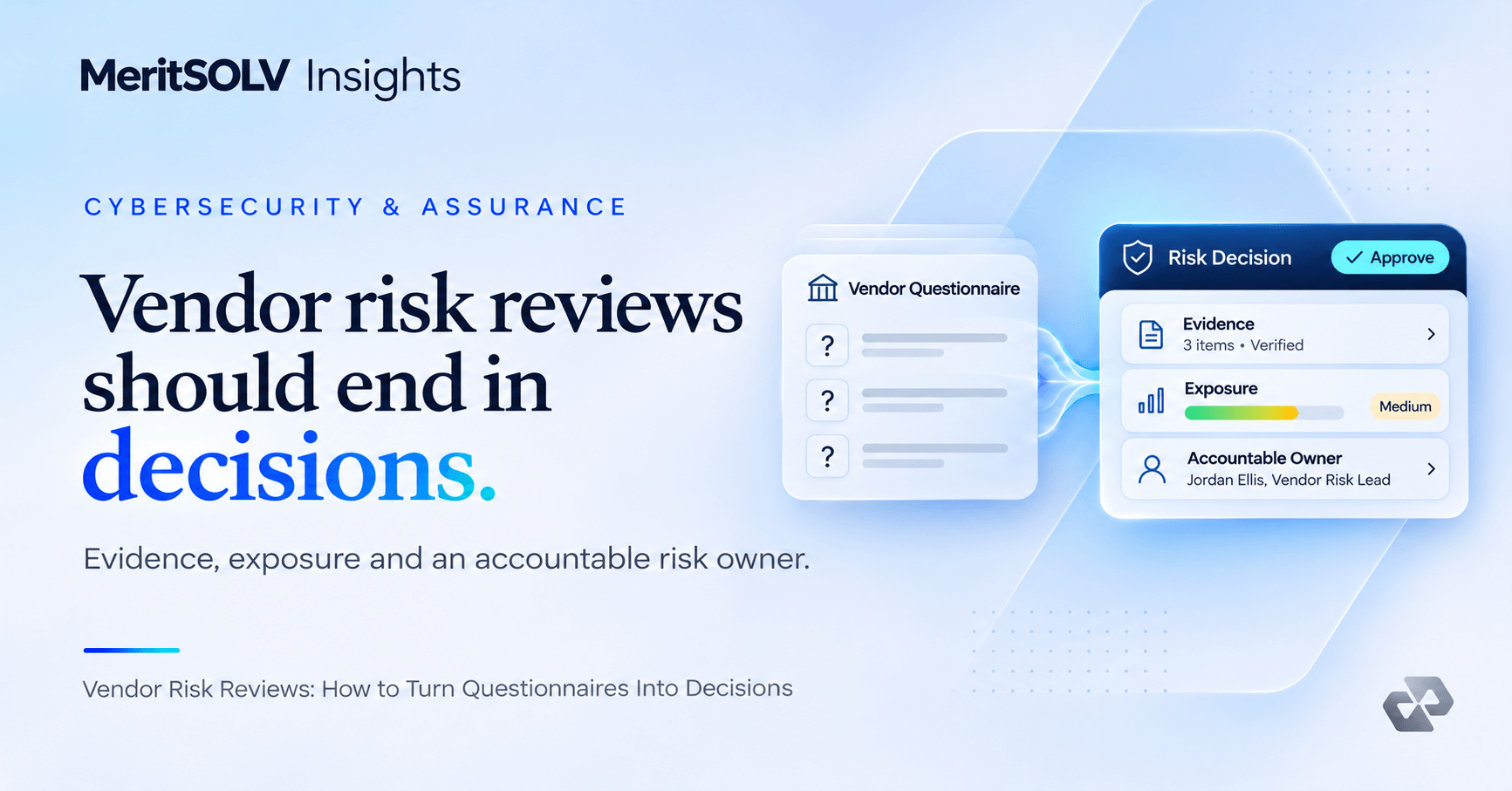
The same discipline applies in reverse when you assess your own suppliers, as described in vendor risk reviews.
How this connects to MeritSOLV
MeritSOLV currently lists the linked package as available for a scoped proposal, subject to triage and approval.
MeritSOLV’s Customer Trust Security Response Sprint provides a useful next reference for teams that want a defined output rather than an unbounded consulting engagement. Its model emphasizes a written scope, a named delivery lead, independent review and documented acceptance. The decision about what to implement, approve or accept remains with the customer.
For the broader set of options, review the MeritSOLV solution catalog and how the process works. Use a small, well-defined first engagement to validate whether the operating model fits your needs.
Frequently asked questions
Can security questionnaires be standardized?
Reusable responses help, provided each answer is reviewed for the specific product and date.
Should sales teams answer technical controls alone?
Material security claims should be approved by accountable control owners.
Standards and further reading
Next step
Choose one real example, complete the checklist, and identify the evidence that would make a decision easier this week. Only after that should you decide whether an internal owner or a scoped external engagement is the right path.
These examples are illustrative, not reports of MeritSOLV™ client engagements. This guide is general operational information, not legal, audit, or certification advice. Review the cited standards and apply your organization's requirements.