Quick answer: Audit evidence readiness means each control assertion has a traceable owner, collection period, source artifact, reviewer, and exception disposition.
Why this problem persists
The controls may exist but evidence is scattered and stale. Auditors ask for proof that a control operated during a period, and a policy statement or a fresh screenshot rarely shows that.
Start with one control that was questioned in the last audit or is likely to be sampled this time, such as a quarterly privileged-access review. Trace it from the policy to the named owner, the population in scope, the dated evidence and the handling of each exception. Every break in that chain becomes a line in the readiness tracker before the auditor's request list arrives.
Worked example: A control-to-evidence chain auditors can follow
Illustrative scenario. A finance platform's access-review control says that privileged accounts are reviewed every quarter. The audit team collects a signed PDF saying 'reviews completed.' That is an assertion, not enough to demonstrate operation. Build a chain from policy to control owner to in-scope population to evidence to exception resolution.
| Control question | Stronger evidence | Common gap |
|---|---|---|
| Who is in scope? | Dated account export and filter criteria | Spreadsheet lacks extraction date |
| Who reviewed? | Named approval or system workflow record | Checkbox with no reviewer |
| Were exceptions addressed? | Ticket ID and closure verification | Flagged account disappears from report |
| What period is covered? | Time-stamped quarterly archive | Only current state is retained |
Test the reviewer experience: Ask a colleague unfamiliar with the control to trace one selected user from the population extract through approval and any corrective action in under ten minutes. That ten-minute target is an internal usability exercise, not an external audit requirement. Never imply that preparing evidence is equivalent to an independent audit opinion or a certification.
A practical five-step method
1. Map each request to a control, accountable owner and exact evidence artifact
Break broad requests into one control claim per row: expected behavior, exact affected system, period, evidence object, control owner and reviewer.
2. Record system of origin, collection date and period covered
Capture original filenames or immutable locations, export parameters, extraction timestamp and the population covered. Do not substitute a current screenshot for historical operation.
3. Check whether a screenshot or export actually supports the control statement
Challenge each artifact: does a training roster demonstrate completion for the required people and period, or only enrollment at one point in time?
4. Track missing, outdated or contradictory evidence separately
Keep missing, stale, inconsistent and unverified evidence in separate queues so management knows whether a control failed or an artifact is unavailable.
5. Rehearse the handoff and set deadlines for owner approval
Run a sample trace from requirement through source record to owner approval. Give owners a correction window and archive the approved version.
What “done” should look like
For this problem, aim for a control-to-evidence tracker and audit-week readiness checklist. It should show provenance, version, owner and outstanding exceptions. The sponsor needs to see what was decided, what was not decided and which actions remain. State the population, sampling method and limitations of any review. A scoped example is not a full assurance engagement.
A quick acceptance test
Ask someone outside the delivery team to locate the latest artifact, identify its accountable owner, explain the top unresolved issue and determine the next authorized action. If any answer depends on someone’s memory, the handoff is incomplete.
Common mistake to avoid
Presenting an organized folder as proof of compliance when its artifacts have not been validated. The remedy is not more paperwork for its own sake. Use the smallest set of artifacts that demonstrates scope, evidence, review and the next decision. Automate only after the underlying responsibilities and exceptions are clear.
Copy-ready working checklist
- Map each request to a control, accountable owner and exact evidence artifact.
- Record system of origin, collection date and period covered.
- Check whether a screenshot or export actually supports the control statement.
- Track missing, outdated or contradictory evidence separately.
- Rehearse the handoff and set deadlines for owner approval.
- Confirm who approves the final output and how corrections will be handled.
- Archive the approved version and record the next review or follow-up date.
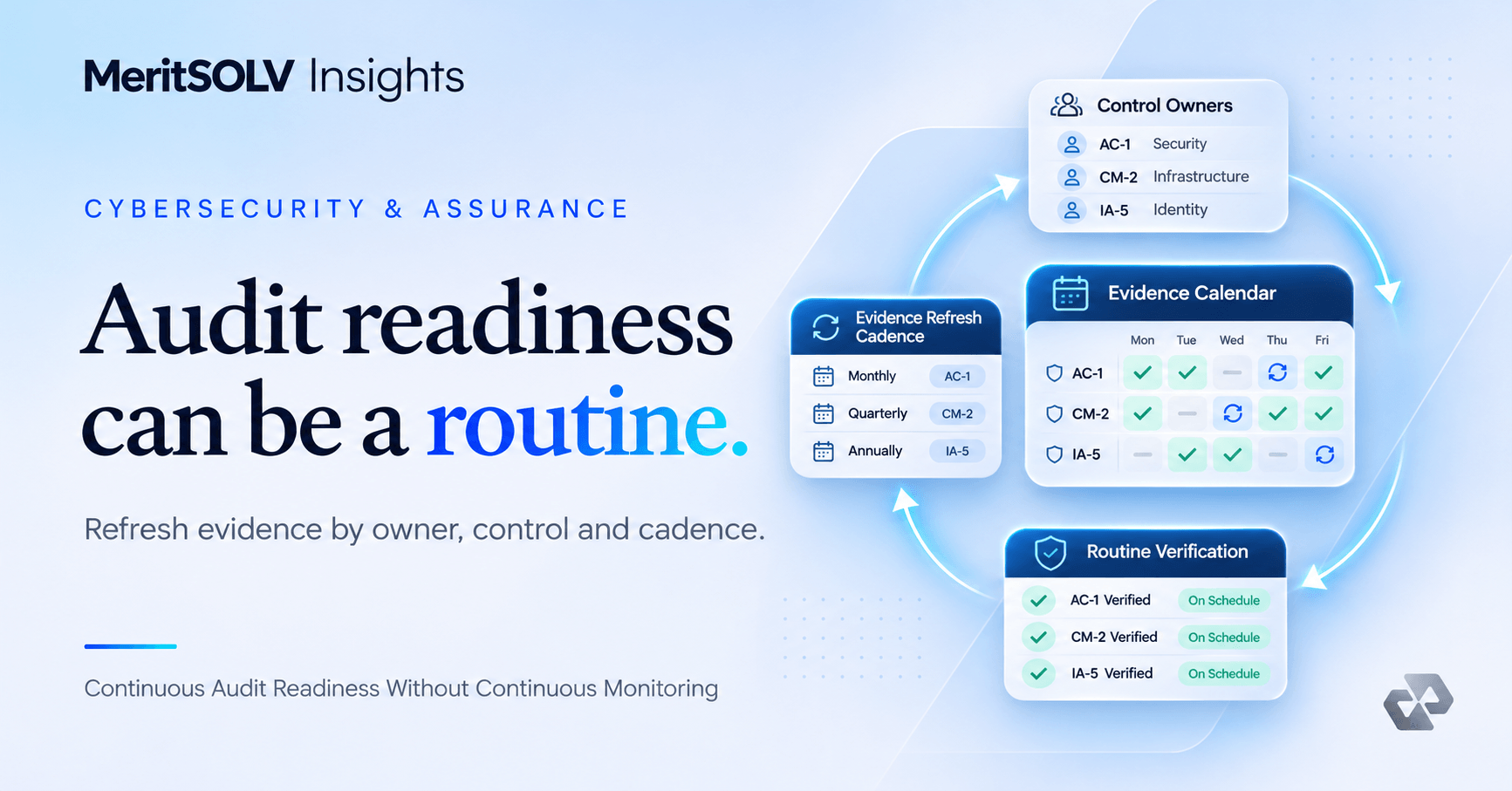
Once the first evidence set is assembled, a continuous audit readiness cycle keeps it current so the next audit does not start from scratch.
How this connects to MeritSOLV
MeritSOLV currently lists the linked package as available for a scoped proposal, subject to triage and approval.
MeritSOLV’s Audit Evidence Readiness Packet provides a useful next reference for teams that want a defined output rather than an unbounded consulting engagement. Its model emphasizes a written scope, a named delivery lead, independent review and documented acceptance. The decision about what to implement, approve or accept remains with the customer.
For the broader set of options, review the MeritSOLV solution catalog and how the process works. Use a small, well-defined first engagement to validate whether the operating model fits your needs.
Frequently asked questions
What is audit evidence readiness?
The discipline of finding, organizing and checking evidence for completeness before independent assessment.
Does this replace an audit?
No. The auditor determines sufficiency and the organization remains responsible for controls.
Standards and further reading
- NIST SP 800-53 Rev. 5: control assurance and evidence
- NIST SP 800-53A Rev. 5: assessing security and privacy controls
Next step
Choose one real example, complete the checklist, and identify the evidence that would make a decision easier this week. Only after that should you decide whether an internal owner or a scoped external engagement is the right path.
These examples are illustrative, not reports of MeritSOLV™ client engagements. This guide is general operational information, not legal, audit, or certification advice. Review the cited standards and apply your organization's requirements.