Quick answer: An IT runbook works when a qualified on-call colleague can identify the trigger, verify preconditions, follow approved actions, and escalate safely without guessing.
Why this problem persists
Critical operations depend on instructions that live only in someone’s head. When a procedure lives in one engineer's memory, an alert at an odd hour becomes a guess about which command is safe.
Ask the current on-call engineers which alert they would least like to handle without help. Write that procedure first, with the trigger, the checks to run before acting, the approved steps and the point at which to stop and escalate. Then have a qualified colleague who did not write it walk through it while the author stays silent.
Worked example: The 2 a.m. runbook test
Illustrative scenario. A network alert fires on a weekend. The runbook says 'restart the service if needed' but provides neither the approved command nor an escalation boundary. An on-call engineer who has never seen the application should be able to identify the alert, verify the system, locate the owner and determine whether an action is authorized, without guessing credentials or production consequences.
| Runbook section | Minimum useful detail |
|---|---|
| Trigger | Alert name, threshold, customer impact signal |
| Preconditions | Permissions, approvals, environment safety checks |
| Read-only diagnosis | Known-good metrics, log locations, expected output |
| Controlled recovery | Approved action, rollback, change ticket requirement |
| Escalation | Primary/secondary contacts and decision clock |
| Closure | Evidence to capture, service owner verification |
Practice on a nonproduction or simulated incident. Ask a qualified engineer to navigate the document and highlight every instruction that relies on private knowledge. Treat credentials as references to an approved vault, never hardcode secrets. Update the runbook when infrastructure changes and assign a named owner and last-verified date.
A practical five-step method
1. Pick a high-frequency or high-impact procedure
Choose a procedure where a delay or wrong command has real consequences. Ask the current on-call engineer which parts currently depend on memory.
2. Capture prerequisites, access needs and safe stopping conditions
Put required permissions, system boundaries, customer-impact checks and rollback authority ahead of any command or configuration action.
3. Write numbered steps with expected outcomes and fallback actions
For every action state the expected signal, what a failure looks like, how to stop, and which log or ticket should capture the result.
4. Have a system owner walk through the document without the author coaching
Let another qualified engineer execute a simulated walkthrough without coaching. Note ambiguous steps, missing screenshots and hidden dependencies.
5. Record version, owner, review date and escalation contacts
Attach an accountable owner, version history, validation date, linked change records, escalation roster and a review trigger after major system changes.
What “done” should look like
For this problem, aim for a reviewed runbook and system-owner approval record. It should show provenance, version, owner and outstanding exceptions. The sponsor needs to see what was decided, what was not decided and which actions remain. State the population, sampling method and limitations of any review. A scoped example is not a full assurance engagement.
A quick acceptance test
Ask someone outside the delivery team to locate the latest artifact, identify its accountable owner, explain the top unresolved issue and determine the next authorized action. If any answer depends on someone’s memory, the handoff is incomplete.
Common mistake to avoid
Publishing a runbook that no one other than its author has tested for clarity. The remedy is not more paperwork for its own sake. Use the smallest set of artifacts that demonstrates scope, evidence, review and the next decision. Automate only after the underlying responsibilities and exceptions are clear.
Copy-ready working checklist
- Pick a high-frequency or high-impact procedure.
- Capture prerequisites, access needs and safe stopping conditions.
- Write numbered steps with expected outcomes and fallback actions.
- Have a system owner walk through the document without the author coaching.
- Record version, owner, review date and escalation contacts.
- Confirm who approves the final output and how corrections will be handled.
- Archive the approved version and record the next review or follow-up date.
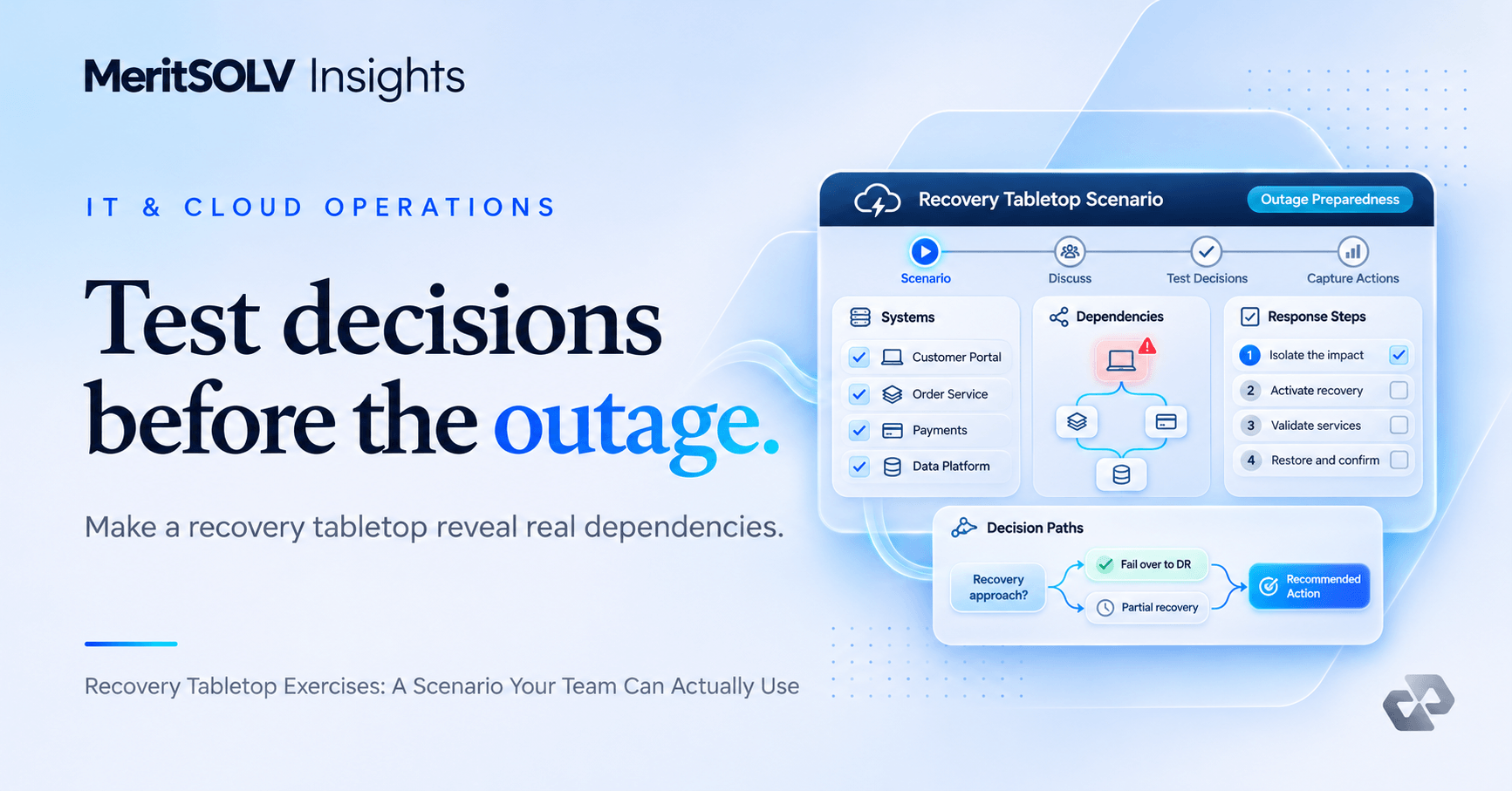
Runbooks are a natural input to a recovery tabletop exercise, which tests whether people can make decisions with them. Clear escalation points also reduce the ticket bouncing described in IT service desk improvement.
How this connects to MeritSOLV
MeritSOLV currently lists the linked package as available for a scoped proposal, subject to triage and approval.
MeritSOLV’s IT Documentation and Runbook Sprint provides a useful next reference for teams that want a defined output rather than an unbounded consulting engagement. Its model emphasizes a written scope, a named delivery lead, independent review and documented acceptance. The decision about what to implement, approve or accept remains with the customer.
For the broader set of options, review the MeritSOLV solution catalog and how the process works. Use a small, well-defined first engagement to validate whether the operating model fits your needs.
Frequently asked questions
What is the difference between an SOP and a runbook?
An SOP describes the standard process. A runbook gives executable operational steps and decision points.
Should a runbook contain passwords?
No. Reference approved credential-management procedures rather than embedding secrets.
Standards and further reading
Next step
Choose one real example, complete the checklist, and identify the evidence that would make a decision easier this week. Only after that should you decide whether an internal owner or a scoped external engagement is the right path.
These examples are illustrative, not reports of MeritSOLV™ client engagements. This guide is general operational information, not legal, audit, or certification advice. Review the cited standards and apply your organization's requirements.