Quick answer: A useful recovery tabletop tests who decides what, when, with limited information. Record decisions, dependencies, missing evidence, and specific retests.
Why this problem persists
Recovery plans often appear complete until real decisions must be made. Plans can list roles and steps without showing whether people can make decisions quickly with incomplete information.
Pick one service that customers would notice within an hour if it failed. Write down who would declare the incident, who would speak to customers and who would decide whether to restore from backup. If the group cannot answer those three questions in the room, that is where the exercise should begin.
Worked example: A 60-minute outage tabletop with actual decision points
Illustrative scenario. A client-facing application is unreachable on a Tuesday morning. At minute zero, the facilitator tells the group that health checks are red and the primary region is unavailable. No root cause is confirmed. At minute 15, the help desk reports 80 customer contacts. At minute 30, an unverified social-media claim blames ransomware. At minute 45, the backup owner states that the last completed restoration test is 11 months old.
| Inject | Decision to make | Evidence to capture |
|---|---|---|
| T+00 application unavailable | Who declares an incident? | Incident role roster |
| T+15 customer demand rises | Who controls customer messaging? | Communications approval path |
| T+30 unverified attribution | What can safely be stated? | Fact/assumption log |
| T+45 recovery uncertainty | Which recovery option is authorized? | RTO/RPO assumptions and sign-off |
Score the exercise by decisions, not by whether the team 'won.' Capture unanswered questions, delegated actions and a retest date. Never treat a tabletop as evidence that restoration will succeed. Pair it with technical recovery tests when feasible. This aligns with the distinction between planning and demonstrated recovery reflected in NIST contingency guidance and incident-response recommendations.
A practical five-step method
1. Choose one critical service and a realistic interruption trigger
Select a service with an agreed business impact, restoration priority and responsible owner. The exercise should start from a plausible, not sensational, interruption.
2. Define assumptions, decision rights and exercise boundaries
State that no production recovery action is authorized by the exercise. Appoint incident commander, communications lead, recorder and facilitator.
3. Create timed injects that reveal dependencies and communication handoffs
Introduce a delayed vendor response, uncertain root cause and stale restore-test evidence at planned times to test escalation and message approval.
4. Capture each decision, uncertainty and owner during facilitation
Record each choice together with available facts, assumptions, escalation reason, authorized owner and the point at which the decision would be revisited.
5. Convert after-action observations into tracked improvements
Publish after-action items with a due date and retest method. Schedule separate technical restoration testing before claiming recovery capability.
What “done” should look like
For this problem, aim for a scenario pack, facilitator guide and after-action template. It should show provenance, version, owner and outstanding exceptions. The sponsor needs to see what was decided, what was not decided and which actions remain. State the population, sampling method and limitations of any review. A scoped example is not a full assurance engagement.
A quick acceptance test
Ask someone outside the delivery team to locate the latest artifact, identify its accountable owner, explain the top unresolved issue and determine the next authorized action. If any answer depends on someone’s memory, the handoff is incomplete.
Common mistake to avoid
Treating a discussion exercise as proof that recovery time objectives have been achieved. The remedy is not more paperwork for its own sake. Use the smallest set of artifacts that demonstrates scope, evidence, review and the next decision. Automate only after the underlying responsibilities and exceptions are clear.
Copy-ready working checklist
- Choose one critical service and a realistic interruption trigger.
- Define assumptions, decision rights and exercise boundaries.
- Create timed injects that reveal dependencies and communication handoffs.
- Capture each decision, uncertainty and owner during facilitation.
- Convert after-action observations into tracked improvements.
- Confirm who approves the final output and how corrections will be handled.
- Archive the approved version and record the next review or follow-up date.
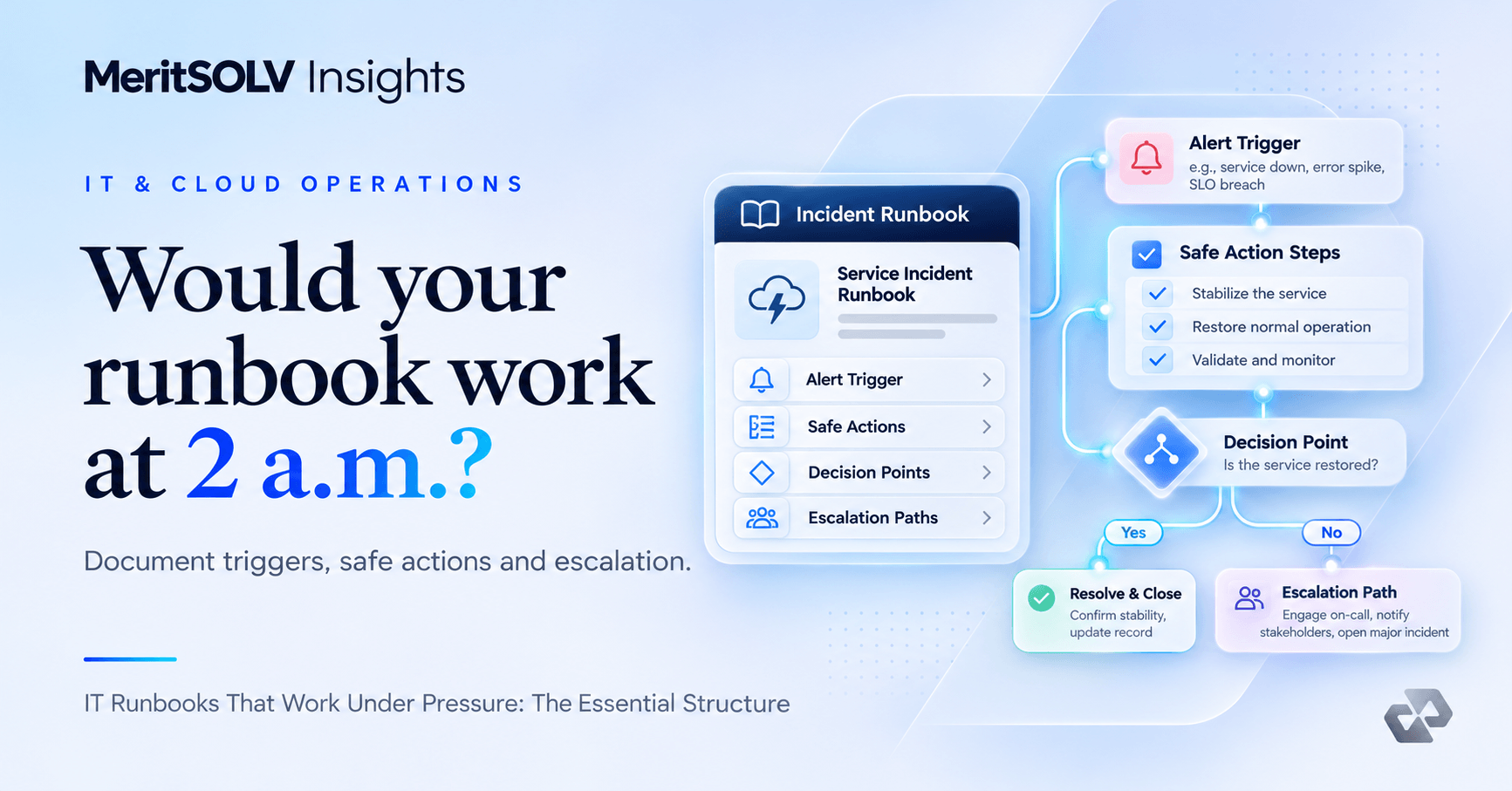
Gaps found in the exercise often point to missing or unclear procedures, which the structure in IT runbooks that work under pressure can fix.
How this connects to MeritSOLV
MeritSOLV currently lists the linked package as available for a scoped proposal, subject to triage and approval.
MeritSOLV’s Recovery Tabletop Preparation provides a useful next reference for teams that want a defined output rather than an unbounded consulting engagement. Its model emphasizes a written scope, a named delivery lead, independent review and documented acceptance. The decision about what to implement, approve or accept remains with the customer.
For the broader set of options, review the MeritSOLV solution catalog and how the process works. Use a small, well-defined first engagement to validate whether the operating model fits your needs.
Frequently asked questions
What should a tabletop exercise test?
Decision-making, communication, dependencies, assumptions and escalation, not live-system recovery.
How long should a tabletop last?
Fit duration to objectives. A focused exercise is often more useful than an oversized scenario.
Standards and further reading
- NIST SP 800-34 Rev. 1: contingency planning
- NIST SP 800-61 Rev. 3: incident response
- NIST SP 800-84: test, training and exercise programs
Next step
Choose one real example, complete the checklist, and identify the evidence that would make a decision easier this week. Only after that should you decide whether an internal owner or a scoped external engagement is the right path.
These examples are illustrative, not reports of MeritSOLV™ client engagements. This guide is general operational information, not legal, audit, or certification advice. Review the cited standards and apply your organization's requirements.