Quick answer: Control gaps should be prioritized by exposure, business consequence, exploitability, and compensating controls rather than inconsistent severity labels alone.
Why this problem persists
Long assessment reports fail when every finding is presented as equally urgent. Findings scored by different assessors with different methods cannot be compared fairly, so effort goes to the loudest item rather than the riskiest.
Take the current list of high findings and rescore several of them with the same questions. How exposed is the asset? How critical is the business process? How easy is the weakness to exploit? What compensating controls exist? Where the answers change the ranking, document why. That shared method is what lets leadership agree on an order.
Worked example: Prioritize the exposure, not the color of the heatmap
Illustrative scenario. A 90-day security review produces 42 findings. Nine are labeled 'high' by separate assessors, but the labels use different methods. Standardize each finding against exploitability, exposure, business criticality, compensating controls and the time needed to verify or remediate it.
| Factor | Sample question |
|---|---|
| Exposure | Is this reachable from the internet or only an isolated lab? |
| Privilege | Can compromise affect sensitive data or tenant administration? |
| Business consequence | Which important process could stop? |
| Compensating control | Is a mitigating control operating and evidenced? |
| Decision authority | Who may accept or defer residual risk? |
An example trade-off: a widely exposed admin role with no phishing-resistant MFA may demand action before a similarly rated issue on an isolated nonproduction machine. Do not turn this into an unsupported numerical scoring formula. Publish the criteria, record contested assumptions, and keep a visible exception backlog. NIST CSF 2.0 is a useful reference for organizing governance and risk decisions, not a substitute for context-specific analysis.
A practical five-step method
1. Start from the control framework and defined organizational scope
Confirm the framework selection, environment boundaries and risk tolerance with business leadership. Otherwise severity comparisons lack common context.
2. Validate each gap against available evidence
For each reported gap, identify the evidence and verification status, including whether an alleged weakness affects a live system.
3. Score impact, likelihood, exposure and business dependency
Assess exposure, potential consequence, exploitability and mitigating controls. Document assumptions instead of trusting inconsistent colored badges.
4. Group actions into immediate, foundational and longer-term work
Split no-regret emergency actions, prerequisite foundational work and planned improvements into separate sequenced backlogs.
5. Assign an owner, estimated effort, prerequisite and success test
Assign accountable owners, evidence-based closure conditions, dependencies and re-review dates. Leave accepted residual risk visible.
What “done” should look like
For this problem, aim for a sequenced, management-ready control improvement roadmap. It should show provenance, version, owner and outstanding exceptions. The sponsor needs to see what was decided, what was not decided and which actions remain. State the population, sampling method and limitations of any review. A scoped example is not a full assurance engagement.
A quick acceptance test
Ask someone outside the delivery team to locate the latest artifact, identify its accountable owner, explain the top unresolved issue and determine the next authorized action. If any answer depends on someone’s memory, the handoff is incomplete.
Common mistake to avoid
Assigning a score without explaining the underlying business context. The remedy is not more paperwork for its own sake. Use the smallest set of artifacts that demonstrates scope, evidence, review and the next decision. Automate only after the underlying responsibilities and exceptions are clear.
Copy-ready working checklist
- Start from the control framework and defined organizational scope.
- Validate each gap against available evidence.
- Score impact, likelihood, exposure and business dependency.
- Group actions into immediate, foundational and longer-term work.
- Assign an owner, estimated effort, prerequisite and success test.
- Confirm who approves the final output and how corrections will be handled.
- Archive the approved version and record the next review or follow-up date.
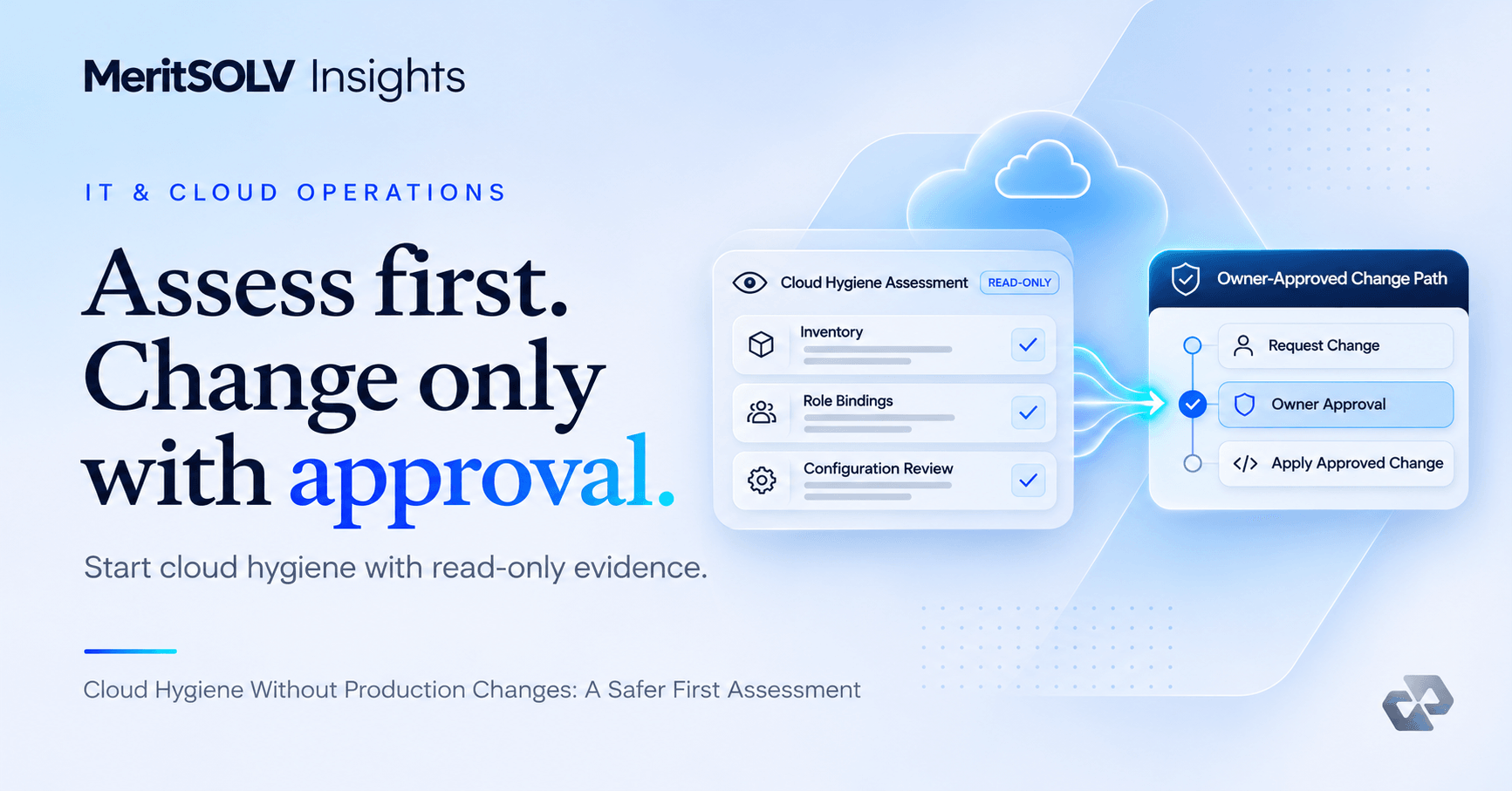
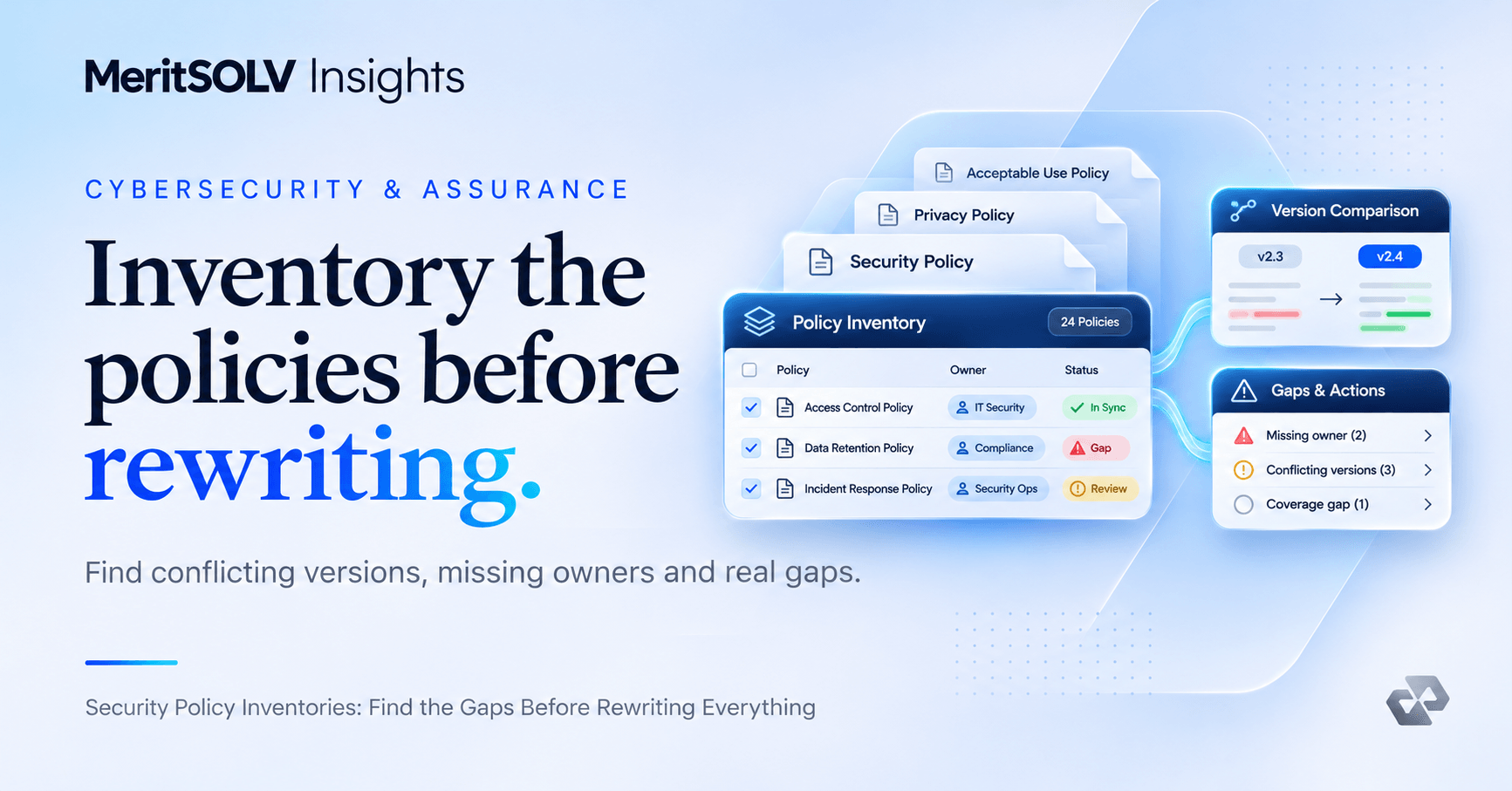
Before rewriting documents in response to findings, a security policy inventory separates missing documents from missing controls. Read-only reviews such as a cloud hygiene assessment are a common source of findings to rank this way.
How this connects to MeritSOLV
MeritSOLV currently lists the linked package as available for a scoped proposal, subject to triage and approval.
MeritSOLV’s Cybersecurity Control Improvement Roadmap provides a useful next reference for teams that want a defined output rather than an unbounded consulting engagement. Its model emphasizes a written scope, a named delivery lead, independent review and documented acceptance. The decision about what to implement, approve or accept remains with the customer.
For the broader set of options, review the MeritSOLV solution catalog and how the process works. Use a small, well-defined first engagement to validate whether the operating model fits your needs.
Frequently asked questions
Is risk ranking the same as compliance ranking?
No. A requirement gap and business risk can overlap but require separate, explicit reasoning.
Who decides which risks to accept?
Authorized management, informed by security and control owners.
Standards and further reading
Next step
Choose one real example, complete the checklist, and identify the evidence that would make a decision easier this week. Only after that should you decide whether an internal owner or a scoped external engagement is the right path.
These examples are illustrative, not reports of MeritSOLV™ client engagements. This guide is general operational information, not legal, audit, or certification advice. Review the cited standards and apply your organization's requirements.